
The William Lee Family Collection
Introduction
William Lee was an English-born traveler, schoolmaster, merchant, and public official whose life carried him from England through several parts of colonial America before he settled in Georgia. His surviving records and writings provide an unusual view of life during the years surrounding the American Revolution.
New Continuing Research Study: Who Was Charity Lee?
Explore the open questions about Charity’s possible earlier marriage and children before William Lee.
The Ball family connection comes through Charlotte Lee, who married William Bartholomew Ball. Research into William Lee and his family therefore forms an important part of understanding the Ball family’s history in Georgia and the family’s later generations.
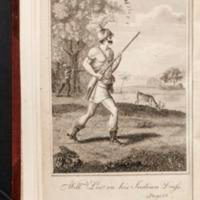
Figure 1. Engraved illustration from William Lee’s published travel narrative, 1808.
William Lee’s Published Travels
William Lee’s travels were published in London in 1808. The work provides an important contemporary source for reconstructing his travels and experiences.
From England to Colonial America
William Lee was born 15 March 1741 at Austerfield, England. His early life began in England, but surviving records later place him in colonial North America. By 21 August 1768, Lee was in New York City.
By October 1771, he was at Linville Creek in Augusta County, Virginia, where he worked as a schoolmaster. In March 1773, his travels carried him into the western country around Fort Necessity and Fort Pitt, placing him on the expanding colonial frontier.
Pensacola and the Gulf Coast
By June 1774, William Lee was in Pensacola, where he became involved in the shipping business. During this period he married Charity, who later appears with him in the account of his life in Georgia.
This period represents another major stage in Lee’s remarkable movement from England → New York → Virginia frontier → Pensacola.
Revolutionary War Era
During the Revolutionary era, William Lee’s movements brought him into the unsettled political and military world of the southern colonies. By 1780, he was associated with Burke County, Georgia, where he established a farm approximately 100 miles from Savannah.
On 20 March 1781, William Lee appears in connection with an Oath of Allegiance at Augusta, Georgia. Later records also place him in civic and legal affairs in the Augusta and Richmond County area.
Burke County, Georgia and the Lee Family
William and his family were living in Georgia when William Lee recorded the birth of a daughter on 7 August 1781. Later Ball family evidence identifies Charlotte Lee as William and Charity Lee’s daughter and associates the family with the Bark Camp Creek area of Burke County. The evidence supporting this identification is examined below.
Charlotte Lee and the Ball Family Connection
Charlotte Lee, later wife of William Bartholomew Ball, is identified through the combined Lee and Ball family evidence as a daughter of William and Charity Lee. William Lee recorded the birth of an unnamed daughter on 7 August 1781, while the surviving Ball family Bible transcription records Charlotte’s birth as 27 August 1781. This discrepancy and the evidence supporting her identification are examined below.
Historical Documents
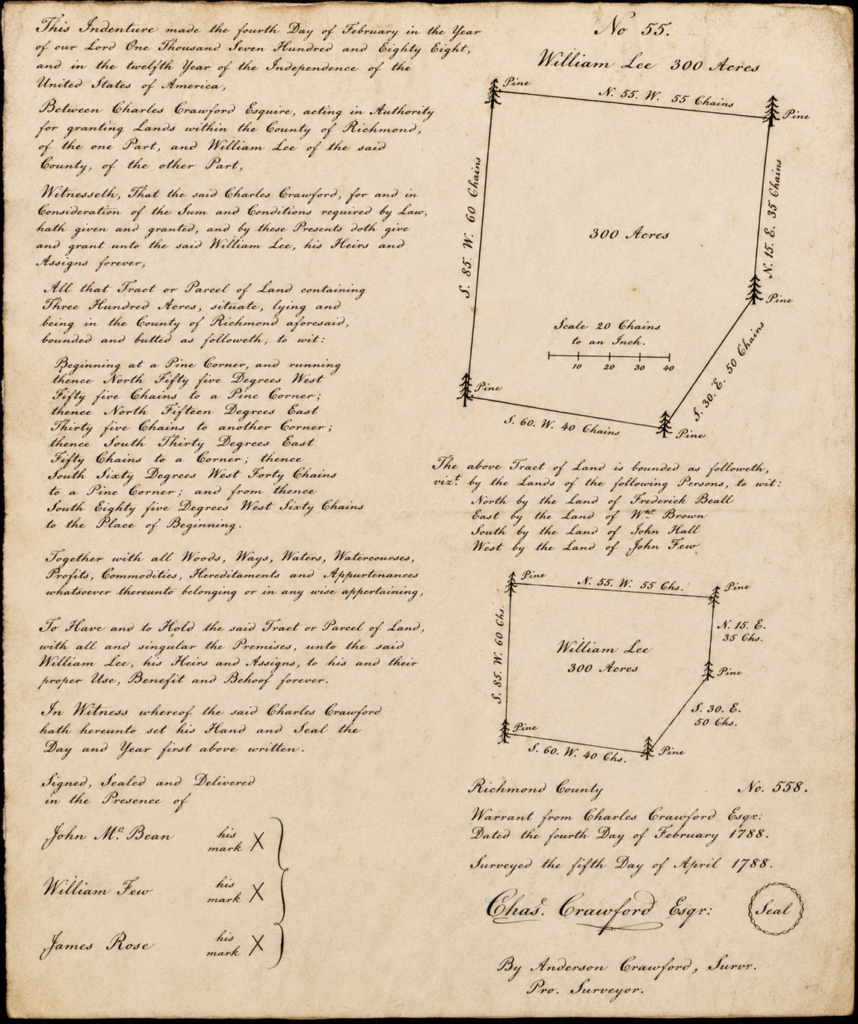
Figure 2. Survey and grant for William Lee’s 300-acre tract, Richmond County, Georgia, surveyed 5 April 1788.
William Lee’s Richmond County Land
This 1788 survey documents William Lee’s 300-acre tract in Richmond County, Georgia. The plat identifies adjoining lands and provides important geographic evidence placing Lee in the Augusta-area community later associated with the Lee and Ball families and their neighboring landowners.
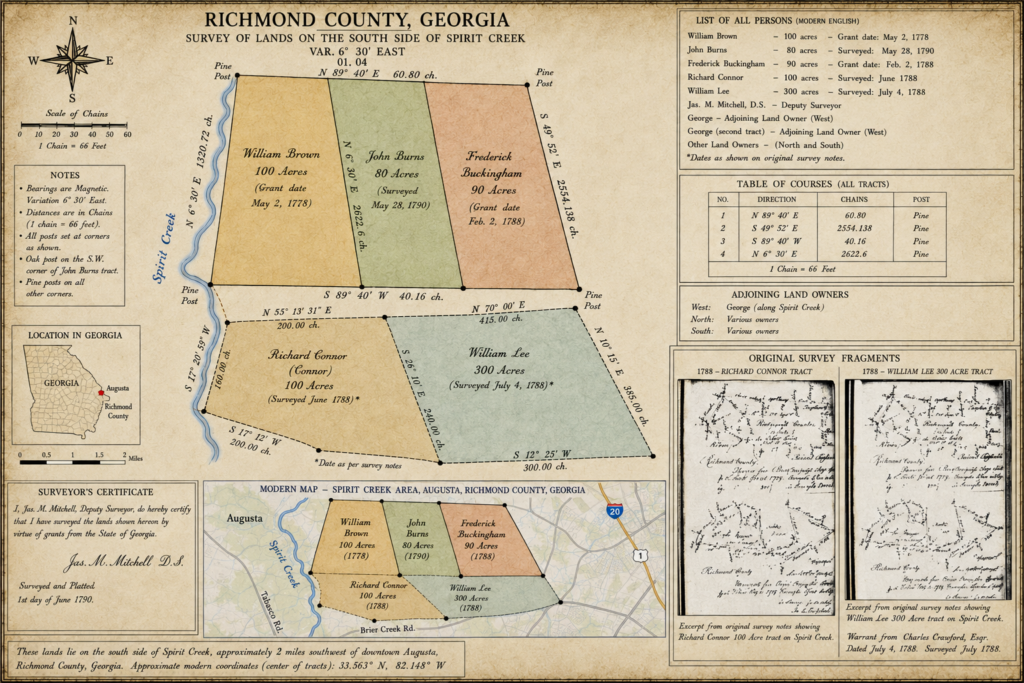
Figure 3. William Lee and Adjoining Lands on Spirit Creek, Richmond County, Georgia.
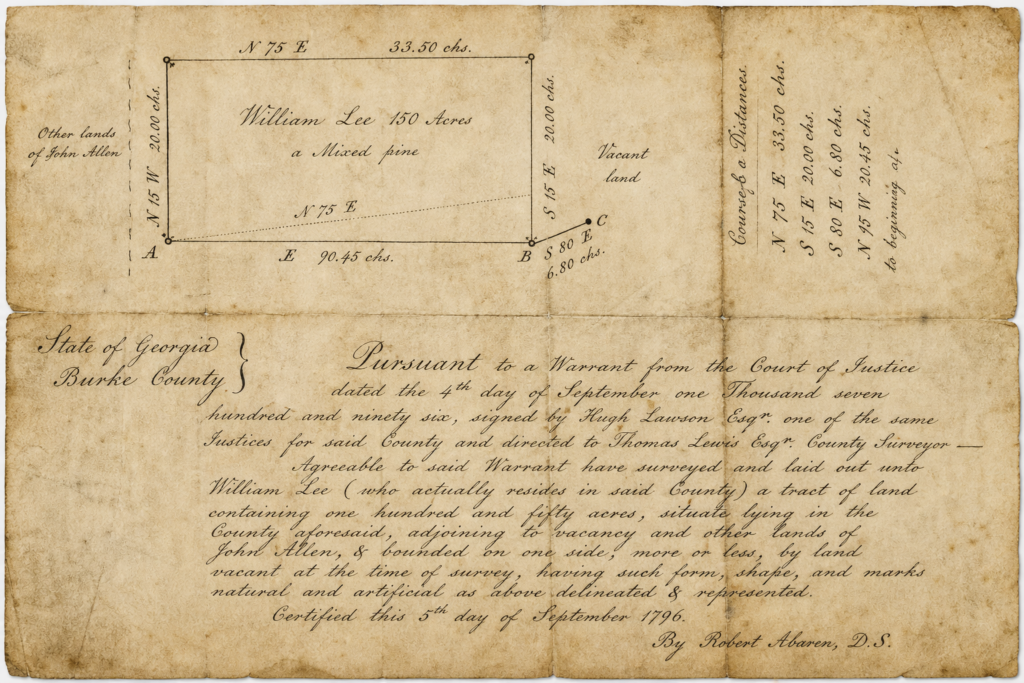
Figure 4. William Lee 150-Acre Land Survey, Burke County, Georgia, 1796.
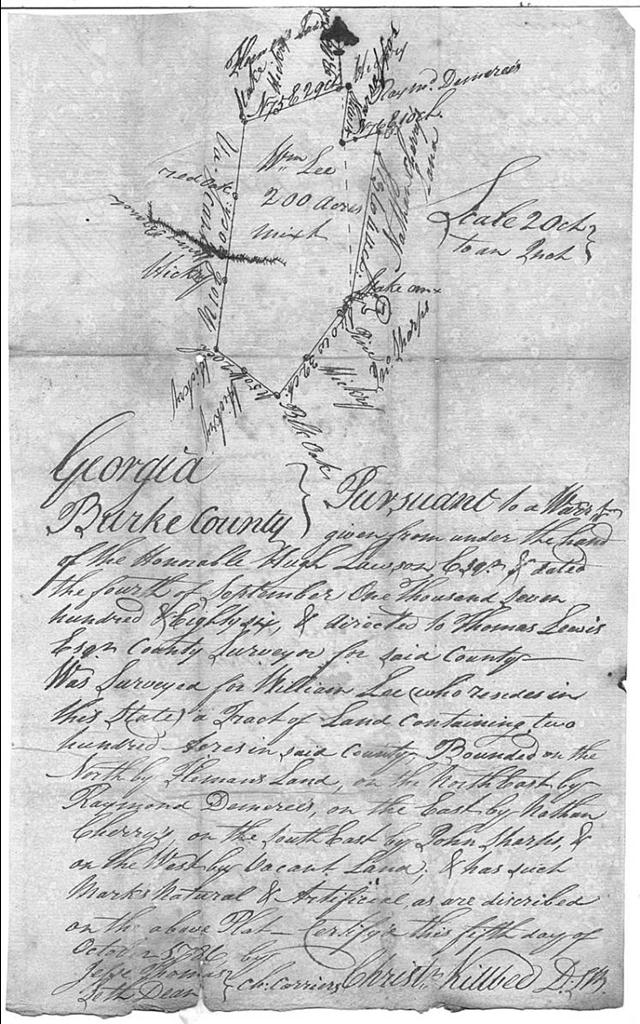
Figure 5. William Lee 200-Acre Land Survey, Burke County, Georgia
Captain William Lee and Jackson’s Legion
An important surviving record dated 12 August 1782 states that Lee had served in Jackson’s Legion and that he wished to command one of the State of Georgia’s new galleys. This provides direct documentary evidence connecting his military service under Jackson with his maritime experience. Lee’s experiences during the Revolution therefore brought together two important parts of his life: military service on land and extensive experience at sea.
Georgia Revolutionary Records
The surviving Georgia records also report that on 16 July 1782, William Lee surrendered himself to Colonel Johnson in Effingham County and was taxed because of his loyalty. Additional records place him in Richmond County and document his later land transactions and public activities.
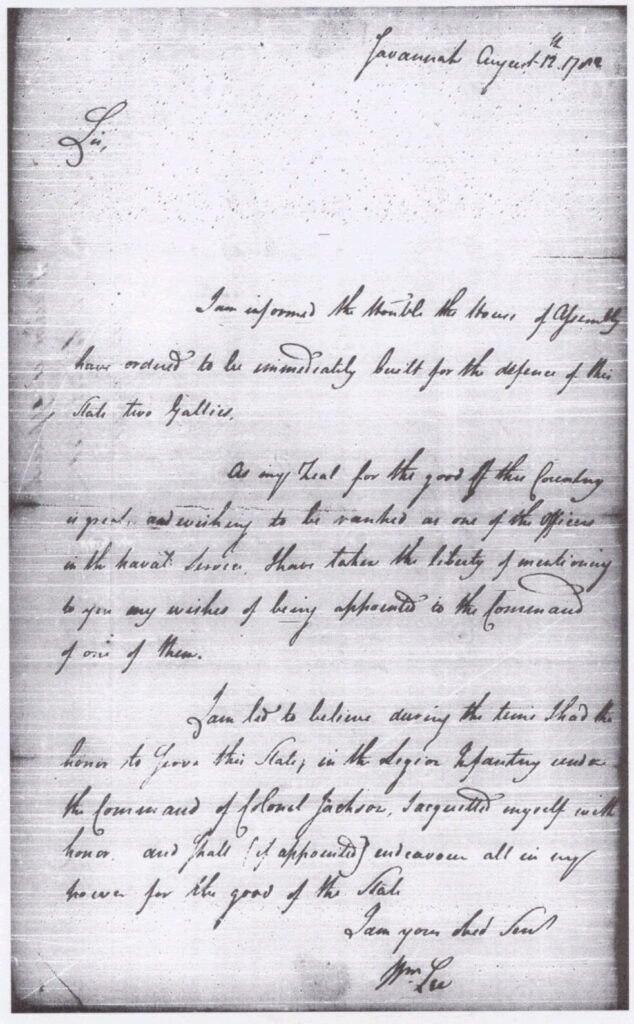
Figure 6. William Lee’s Letter Requesting Command of a Georgia Galley, 12 August 1782
William Lee Seeks a Naval Command
In this letter written at Savannah on 12 August 1782, William Lee informed Georgia authorities that he had heard that two galleys were to be immediately built for the defense of the state. Drawing upon his previous experience in naval service, Lee requested that he be considered for appointment to command one of them.
Lee also referred to his wartime service in Colonel James Jackson’s Legion, making the letter particularly important because it connects two parts of his Revolutionary career: his service with Jackson and his experience as a mariner.
The document is direct contemporary evidence written by William Lee himself and strengthens the documentary record of his Revolutionary War service.
William Lee — Life and Travels, 1741–1808
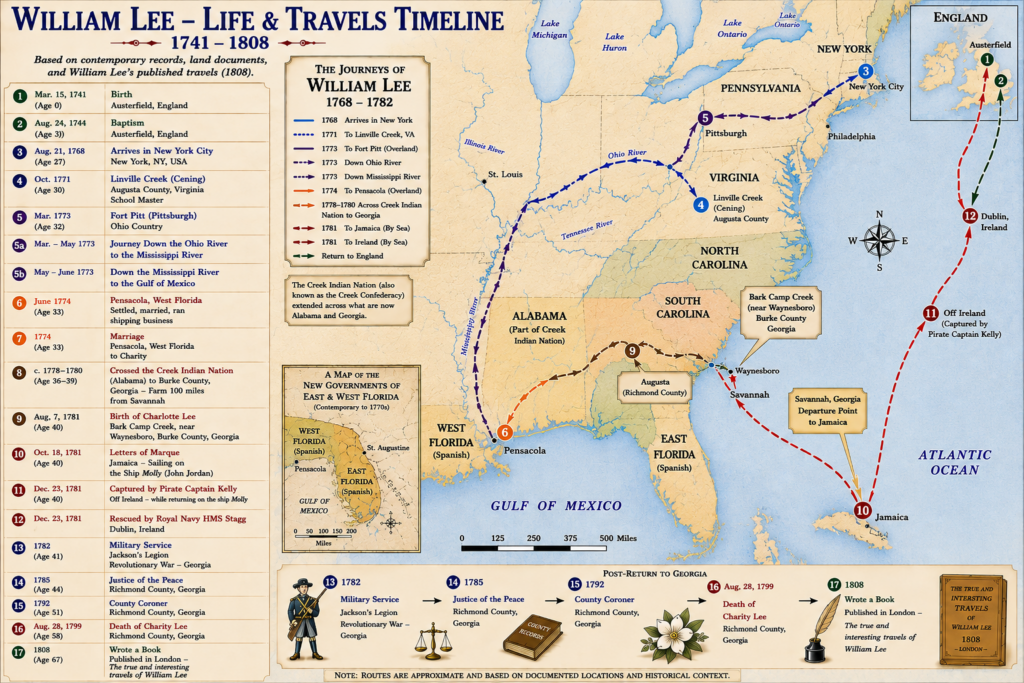
Figure 7. William Lee — Life and Travels Timeline, 1741–1808. The map reconstructs Lee’s documented travels from England through New York, Virginia, the Ohio and Mississippi river systems, Pensacola, Georgia, Jamaica, Ireland, and England. Locations and routes are approximate and are based on surviving records and Lee’s published 1808 narrative.
Estimated Lifetime Travel: More Than 8,000 Miles
Between England, colonial America, the Ohio and Mississippi river systems, the Gulf Coast, Georgia, Jamaica, Ireland, and his return to England, William Lee traveled an estimated 8,000–10,000 miles during his remarkable life.
William Lee’s Legacy
William Lee’s life reflects the extraordinary mobility of the Revolutionary generation. From England to New York, Virginia, the Ohio and Mississippi river country, Pensacola, the Creek Indian Nation, Georgia, Jamaica, Ireland, and eventually back to England, his travels crossed much of the eighteenth-century Atlantic world.
His surviving land records, public service in Richmond County, Georgia, and his published 1808 travel narrative provide an unusually detailed record of his life.
For the Ball family, Lee’s most important legacy continued through his daughter, Charlotte Lee, who married William Bartholomew Ball on 1 January 1796. Through their descendants, the Lee family became part of the continuing history of the Ball family.
Identification of Charlotte Lee’s Parents
In 1988–1989, R. C. Ball of Houston undertook an investigation into the parentage of Charlotte Lee, wife of William Bartholomew Ball. Ball had been a driving force behind Mrs. Mills’s research into what became known within the family as the “Ball Problem.” His research included correspondence with historian Robert Scott Davis, Jr., author of Georgians in the Revolution: At Kettle Creek (Wilkes County and Burke County), which includes a sketch of William Lee on pages 215–228.
As part of this investigation, Davis commissioned the English genealogical researcher Peter Wilson Coldham to investigate William Lee’s origins in England. That research reportedly established several generations of Lee’s English ancestry. The surviving correspondence and research files assembled by R. C. Ball document the development of the case identifying this William Lee as the father of Charlotte Lee.
William Lee was in New York City by 21 August 1768 and subsequently traveled extensively through the colonies and frontier. His experiences were eventually published in England in 1808 as The True and Interesting Travels of William Lee. During the Revolutionary period, William and his wife, Charity Lee, were living in Georgia.
An especially important piece of evidence concerns a daughter born to William and Charity Lee on 7 August 1781 while the family was in Georgia. William Lee’s published account records the birth but does not identify the infant daughter by name. The surviving Ball family Bible transcription records Charlotte Lee, wife of William Bartholomew Ball, as born 27 August 1781. The twenty-day discrepancy remains unresolved and is examined below. The Bible record nevertheless provides important independent family evidence connecting Charlotte with the Lee family.
Geography provides further circumstantial evidence. Records from Richmond County, Georgia, where William Bartholomew Ball and Charlotte Lee married, place William Lee, William Brown, and members of the Ball family in the same general area along Butler Creek and Spirit Creek near Augusta. William Lee appears in Richmond County records in public and business capacities, including service as a coroner and involvement in local affairs.
The R. C. Ball correspondence also investigated the Brown family connection. William Brown is identified in letters of administration as a son of John Brown. Bartholomew Ball served as administrator of John Brown’s estate as nearest of kin. The surviving research correspondence further records the assertion that Bartholomew later married John Brown’s widow; this statement should be treated as part of the research history unless independently confirmed by a surviving marriage, probate, or other contemporary record.
Taken together—the 1781 birth recorded by William Lee, the Ball family Bible evidence, the marriage of Charlotte Lee and William Bartholomew Ball, the close geographic association of the Lee, Ball, and Brown families around Augusta, and the research conducted by R. C. Ball, Robert Scott Davis Jr., and Peter Wilson Coldham—these materials form a substantial historical and genealogical case for identifying William and Charity Lee as the parents of Charlotte Lee.
Research Provenance
The identification of William and Charity Lee as the probable parents of Charlotte Lee was investigated extensively by R. C. Ball of Houston during 1988–1989, working with historian Robert Scott Davis Jr. As part of that investigation, Davis commissioned English genealogical researcher Peter Wilson Coldham to investigate William Lee’s English origins and ancestry. The surviving R. C. Ball research files and correspondence preserve the development of this genealogical investigation and the evidence considered in reaching the identification.
Ball Family Research
R. C. Ball’s published family research and surviving correspondence form an important part of the modern investigation of the Ball family and the parentage of Charlotte Lee. His 1988–1989 research brought together family records, Georgia documentary evidence, the work of historian Robert Scott Davis Jr., and genealogical research conducted in England by Peter Wilson Coldham.
Online Research and Historical Material
The William Lee/Captain Facebook page served as an online gathering place for research, documents, photographs, and discussion concerning the life and travels of William Lee. It is retained here as a supplementary research resource and as part of the history of the modern investigation into William Lee and his connection to the Ball family.
Research Correspondence and the Charlotte Lee Identification
During 1988–1989, R. C. Ball investigated the parentage of Charlotte Lee, wife of William Bartholomew Ball, building upon earlier Ball family research. His surviving correspondence documents an exchange of information with historian Robert Scott Davis Jr. concerning William Lee and the Georgia evidence.
As part of this investigation, Davis commissioned English genealogical researcher Peter Wilson Coldham to investigate William Lee’s origins in England. Coldham’s work extended the investigation into Lee’s English ancestry and became part of the research assembled by R. C. Ball.
These materials are significant because they preserve the research history behind the identification of Charlotte Lee’s parents and allow the conclusion to be evaluated alongside the surviving family Bible, William Lee’s published narrative, and Georgia records.
Documentary Evidence
Henry Augustus Ball Family Bible
The Henry Augustus Ball family Bible tradition, preserved in the 30 June 1954 letter of Rev. Paul Z. Ball to Mrs. Horace B. Slimp, records Charlotte Lee, wife of William Bartholomew Ball, as born 27 August 1781.
The importance of the Bible record is that it independently preserves Charlotte Lee’s identity within the William Bartholomew Ball family, while William Lee’s contemporary published account records that his wife gave birth to an unnamed daughter on 7 August 1781. The Bible transcription and Lee’s account therefore preserve two closely corresponding records, but with a twenty-day difference in the reported birth date. The reason for that difference is not presently known and is examined separately below.
Birth-Date Discrepancy
William Lee’s published narrative records the birth of a daughter to William and Charity Lee on 7 August 1781, while the Ball family Bible record, as preserved in the 1954 transcription and subsequently published in the Georgia Genealogical Society Quarterly, gives Charlotte Lee’s birth as 27 August 1781.
The twenty-day difference could represent a copying, transcription, typesetting, or editorial error introduced as the Bible information was transmitted and later published. Because the original Bible entry has not yet been examined for comparison, the discrepancy cannot presently be resolved.
Both dates are therefore preserved in this study.
Why This Record Matters
The Ball family Bible record independently preserves Charlotte’s maiden name as Lee and identifies her as the wife of William Bartholomew Ball. It records her birth as 27 August 1781, only twenty days after William Lee’s published narrative records that his wife gave birth to an unnamed daughter on 7 August 1781.
When considered together with the marriage evidence, Richmond County land records, geographic proximity of the Lee and Ball families, and surviving R. C. Ball research correspondence, the Bible record provides an important piece of evidence supporting the genealogical identification of William and Charity Lee as the parents of Charlotte Lee.
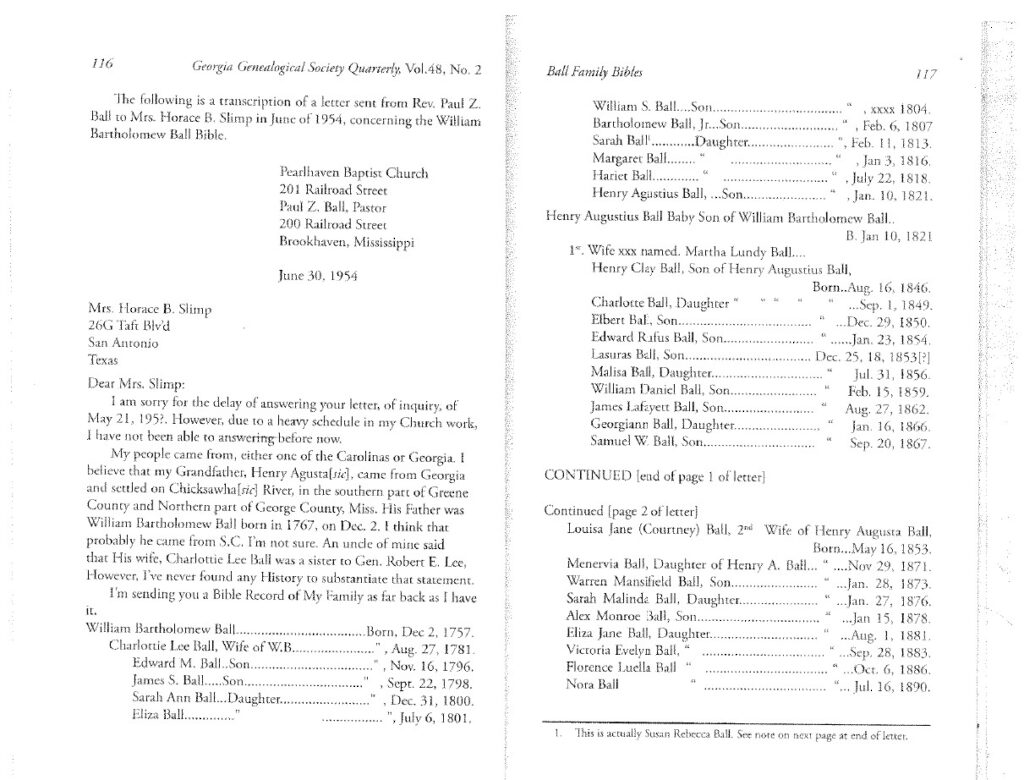
Figure 8. Ball Family Bible record as preserved in the 30 June 1954 letter of Rev. Paul Z. Ball and published in the Georgia Genealogical Society Quarterly, Vol. 48, No. 2, pp. 116–117.
Birth of William and Charity Lee’s Daughter — 7 August 1781
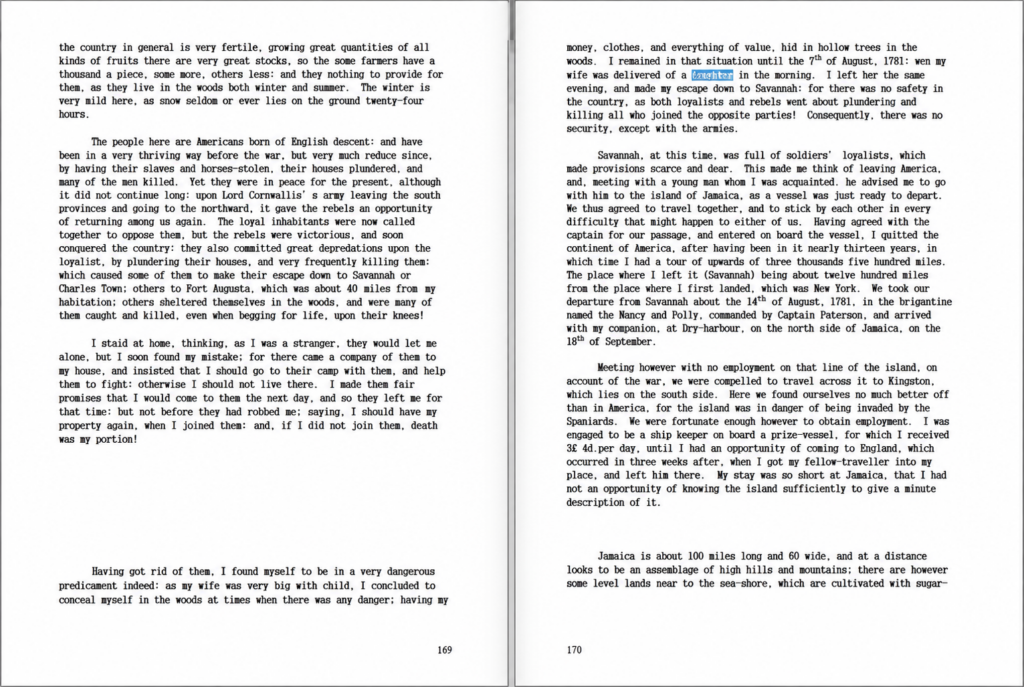
Figure 9. William Lee’s published account describing the violence in Georgia, the birth of his daughter on 7 August 1781, his escape to Savannah, and his subsequent voyage to Jamaica. From William Lee, The True and Interesting Travels of William Lee (1808), pp. 169–170.
Why William Lee Left Georgia — August 1781
William Lee’s own narrative explains the circumstances that forced him to leave Georgia during the Revolutionary War. He described the country as divided between Whigs and Loyalists, with violence, raids, destruction of homes, and retaliatory killings affecting the inhabitants. Lee wrote that his own house had been destroyed and that he feared remaining openly at his plantation.
After attempting to avoid the conflict, Lee eventually joined the Whig forces, explaining that he believed he could no longer remain safely neutral. The deteriorating situation ultimately caused him to leave his wife and family in Georgia and make his way to Savannah.
Lee departed Savannah aboard the brigantine Nancy and Polly, commanded by Captain Paterson, and sailed for Jamaica, arriving at Dry Harbour on 18 September 1781. His account therefore provides a first-person explanation for his departure from Georgia only weeks after the birth of his daughter on 7 August 1781.
Conclusion: Identification of Charlotte Lee
The surviving evidence supports a genealogical conclusion that Charlotte Lee, wife of William Bartholomew Ball, was the daughter of William and Charity Lee. This identification rests upon the cumulative evidence of several records rather than upon a single surviving document explicitly naming Charlotte as their daughter.
William Lee’s published narrative records that his wife gave birth to an unnamed daughter on 7 August 1781. Independently, the Henry Augustus Ball family Bible tradition, preserved in the 30 June 1954 letter of Rev. Paul Z. Ball, identifies Charlotte Lee as the wife of William Bartholomew Ball and records her birth as 27 August 1781.
The twenty-day difference between the two birth dates remains unresolved. Because the original Bible entry has not yet been examined for comparison, both dates are preserved in this study rather than choosing one over the other without documentary proof.
The identification is further supported by the surviving Georgia records, marriage evidence, family records, and later genealogical research. Considered together, these sources form the cumulative documentary case connecting Charlotte Lee with the family of William and Charity Lee.
No single surviving record presented here names the infant born on 7 August 1781 as Charlotte Lee. The identification should therefore be understood as a documented genealogical conclusion based upon the combined evidence.
Sources and Documentation
Primary Source — William Lee
Lee, William. The True and Interesting Travels of William Lee, Born at Hadfield, near Doncaster… London: Printed for T. and R. Hughes at the Franklin Press, 1808. See especially pp. 169–170 for Lee’s account of events in Georgia, the birth of his daughter on 7 August 1781, and his departure for Jamaica.
Ball Family Bible
“Ball Family Bibles.” Georgia Genealogical Society Quarterly, Vol. 48, No. 2, pp. 116–117. Contains the transcription of the 30 June 1954 letter from Rev. Paul Z. Ball to Mrs. Horace B. Slimp concerning the William Bartholomew Ball family Bible. This published transcription preserves the family record used in this study for Charlotte Lee’s recorded birth date of 27 August 1781.
Robert Scott Davis Jr.
Davis, Robert Scott, Jr. Georgians in the Revolution: At Kettle Creek (Wilkes County and Burke County). Easley, South Carolina: Southern Historical Press, 1986. See pp. 215–228 for the material concerning William Lee.
R. C. Ball Research
Ball, R. C. William Ball South Carolina 1700: A Chronology of William Ball of St. Johns Parish, Berkeley County, South Carolina and Some of His Descendants. Also consult the surviving 1988–1989 R. C. Ball research correspondence concerning Charlotte Lee and William Lee, including the exchange of research with Robert Scott Davis Jr.
Peter Wilson Coldham Research
Research commissioned through Robert Scott Davis Jr. from English genealogist Peter Wilson Coldham concerning William Lee’s English origins and ancestry. Coldham’s research reportedly established several generations of Lee’s English ancestry. The surviving Coldham material and related correspondence form part of the R. C. Ball research files and preserve important documentation concerning the investigation of William Lee and the identification of Charlotte Lee’s parentage.
Georgia Records
Georgia Records. Richmond County and Burke County, Georgia, land grants, surveys, deeds, estate records, and public records relating to William Lee and associated families. These records document Lee’s landholdings and activities in Georgia and provide geographic context for the Lee–Ball family investigation. Georgia Revolutionary records also document Lee’s 1782 service in Jackson’s Legion and his 12 August 1782 request for command of one of Georgia’s new galleys.