
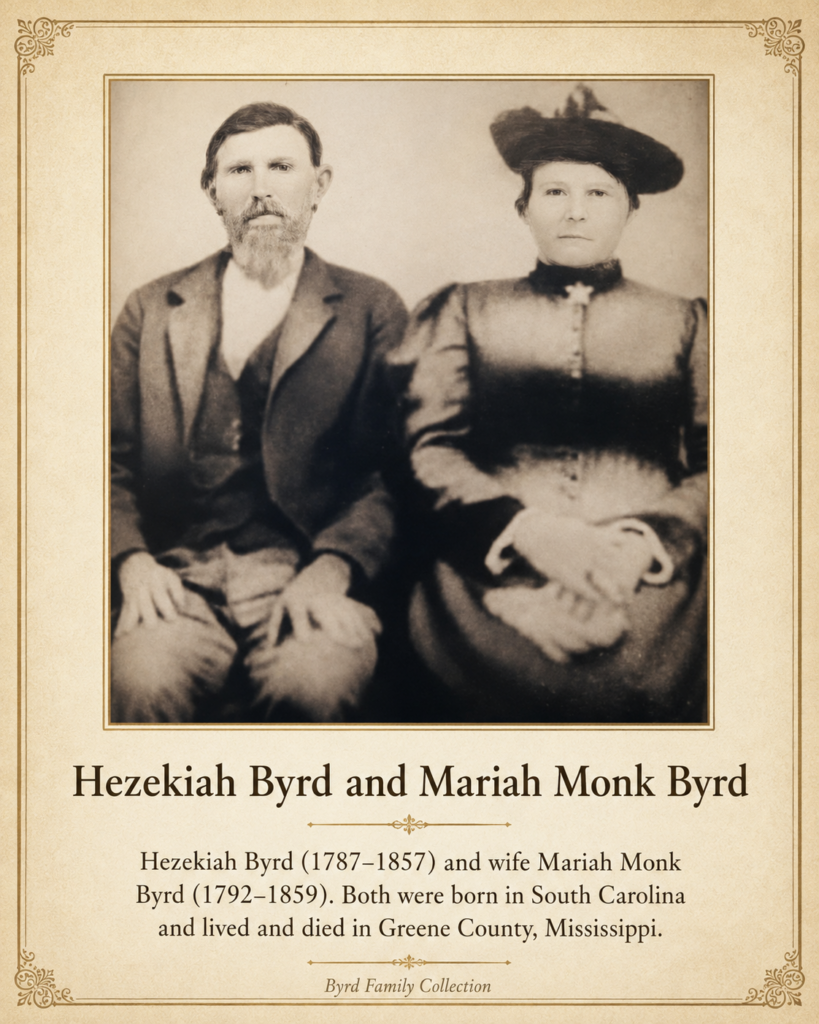
Hezekiah Byrd in Greene County, Mississippi
The Byrd family compilation places Hezekiah Byrd as born in 1787 in Orangeburg District, South Carolina, and dying in 1858 in Greene County, Mississippi, southwest of Neely. It identifies his wife as Mariah Monk, born in 1792 in Orangeburg District and dying about 1868 in Greene County. These dates and places are useful family-research leads and should be checked against original records before being treated as final proof.
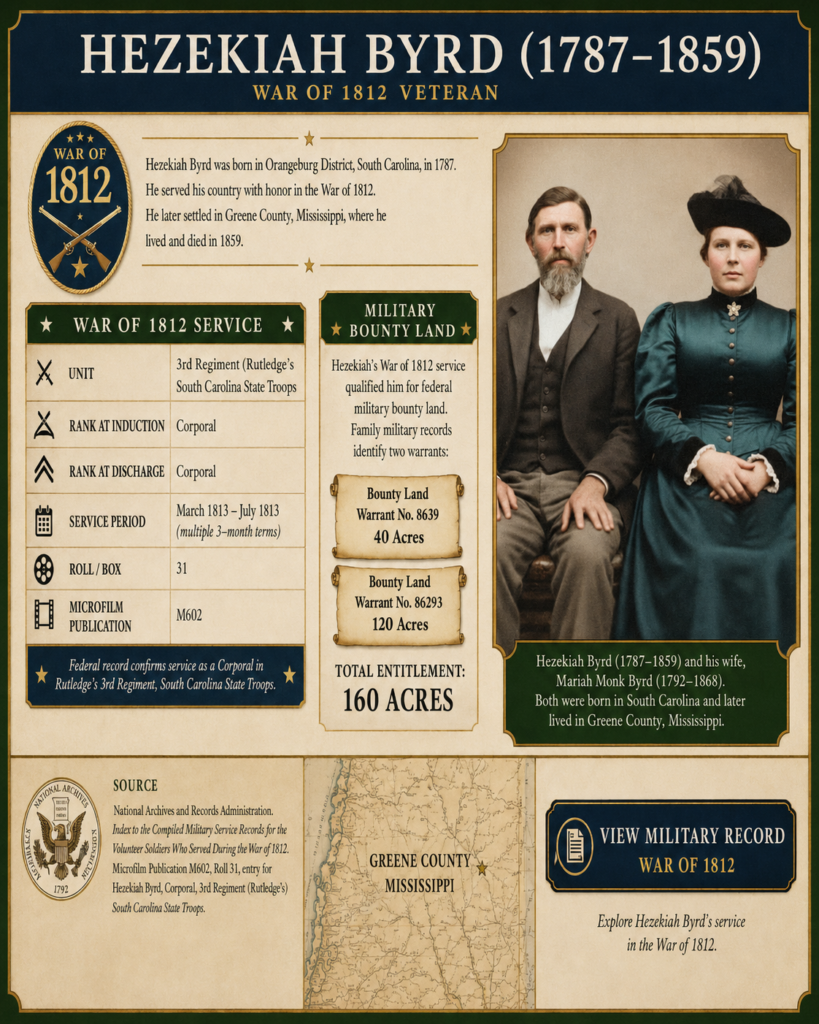
The same compilation states that Hezekiah served in the South Carolina Militia in March and July 1813 and received bounty-land awards of 40 acres and 120 acres. The original military and bounty-land records should be cited before these statements are presented as fully documented conclusions.
Hezekiah and his family were remembered as living near the forks of Atkinson Creek and the Leaf River in the area called Courthouse Bluff. Published Greene County history identifies Boise Bluff, also called Courthouse Bluff, on the east bank of the Leaf River near present-day McLain as the location of Greene Courthouse, the county’s first seat of government. The first courthouse was built there in 1811, and the county seat was moved to Leakesville in 1827. This places the Byrd family tradition within the same early Leaf River settlement zone, although the exact Byrd homesite should not be assigned without a land record.
Family tradition states that Hezekiah farmed and raised cattle, hogs, and other livestock. He was said to have been buried on the north side of his property, with Mariah and some of their children buried nearby. The compilation reports that the graves were later destroyed and the ground converted to pasture and that the incident was recorded in Greene County court records. That reported court record still needs to be located and verified.
Parentage remains unproven. The family compilation itself warns that no documentation has been found proving Hezekiah was a son of Michael King Byrd and Laney Branch. That relationship should therefore remain identified as an unconfirmed family tradition.
Children Listed in the Family Compilation
The working genealogy lists ten children of Hezekiah Byrd and Mariah Monk:
- Josiah Walton Byrd Sr., born 1816
- Edward Washington Byrd, born 1817
- John A. Byrd Sr., born about 1820
- Malachi G. “Mally” Byrd, born 1827
- Elizabeth “Betsy” Byrd, born 1830
- Ezekiel Byrd, born 1831
- Bartlett S. Byrd, born 1834
- Michael K. Byrd, born 1834
- Charles Byrd, born 1838
- James Byrd, born 1840
This list comes from the family compilation and should be reconciled with census, land, probate, military, church, and cemetery records as research continues.
Greene County Communities Connected to the Byrd Family
Courthouse Bluff / Boise Bluff. One of the earliest recorded settlements in Greene County. Greene Courthouse stood on the east bank of the Leaf River near present-day McLain, where important early roads crossed. This is the community most directly associated with Hezekiah in family tradition.
Neely, Buffalo, and Buck Creek. The family compilation says Josiah Walton Byrd Sr. moved into the Buffalo-Buck Creek area west of Neely after his marriage to Mahala Breland. Several descendants remained in this general area, and Washington Cemetery at Neely appears repeatedly in the family genealogy.
Avera and Mutual Rights. Several Byrd descendants were associated with the Avera area. The compilation places Robert Nicholas Byrd and members of his family at Mutual Rights Cemetery near Avera.
Pleasant Hill. Later generations of the Josiah Walton Byrd line were closely connected with Pleasant Hill. The compilation records Josiah Walton Byrd Jr. as dying there in 1938 and lists numerous Byrd burials in Pleasant Hill Cemetery.
McLain and Leaf. The old Courthouse Bluff settlement was near modern McLain. The family compilation also records later Byrd descendants living and being buried at McLain, while published county history identifies Leaf as another important early Leaf River community.
Richton, Brewer, Arlington, and Beaumont. One branch moved farther west and south. The family account says Absalom B. Byrd left the Buck Creek area, lived near the Brewer community east of Richton, later moved to the Fairhope district now associated with Arlington, and worked in the timber and turpentine industries. His descendants extended into the Beaumont area.
Byrd, Mississippi, and the “Nick Byrd” Question
Published Greene County town history describes Byrd, about fourteen miles northwest of Leakesville, as a sawmill community associated with the Cowan Lumber Company and says the town was named for Nick Byrd. Postal-history records list a Byrd post office from 1904 to 1908.
The Hezekiah Byrd family compilation contains a Robert Nicholas Byrd (1865–1921), identified there as a grandson of Hezekiah through Edward Washington Byrd. Robert Nicholas lived in Greene County and was buried at Mutual Rights Cemetery near Avera. Because the town history gives only the name “Nick Byrd,” Robert Nicholas is a plausible candidate for the namesake, but the connection is not yet proven. A published or original record explicitly identifying the town’s Nick Byrd is still needed.
Byrd–Ball Family Connection
The compilation records Leona Virginia Byrd (1882–1968), a descendant of Hezekiah through Josiah Walton Byrd Sr. and Jefferson Davis Byrd, as marrying Alexander Monroe Ball in Greene County in 1900. This marriage is one of the direct links between the Byrd and Ball families represented in Ball Family Association research.
Sources and Research Status
- Brooks Ball, “History of Greene County – Part 3,” Greene County Herald, August 4, 2017.
- Cyril Edward Cain, Four Centuries on the Pascagoula, 1953.
- United States Post Office Department, Record of Appointments of Postmasters, State of Mississippi, 1832–1930, National Archives reproduction, held by the Mississippi Department of Archives and History.
- Greene County town-history compilation for the Byrd sawmill community and the Nick Byrd place-name tradition.
- Descendants of Hezekiah Byrd, unpublished family compilation. Used here as a research aid for family relationships and community associations, not as stand-alone proof.