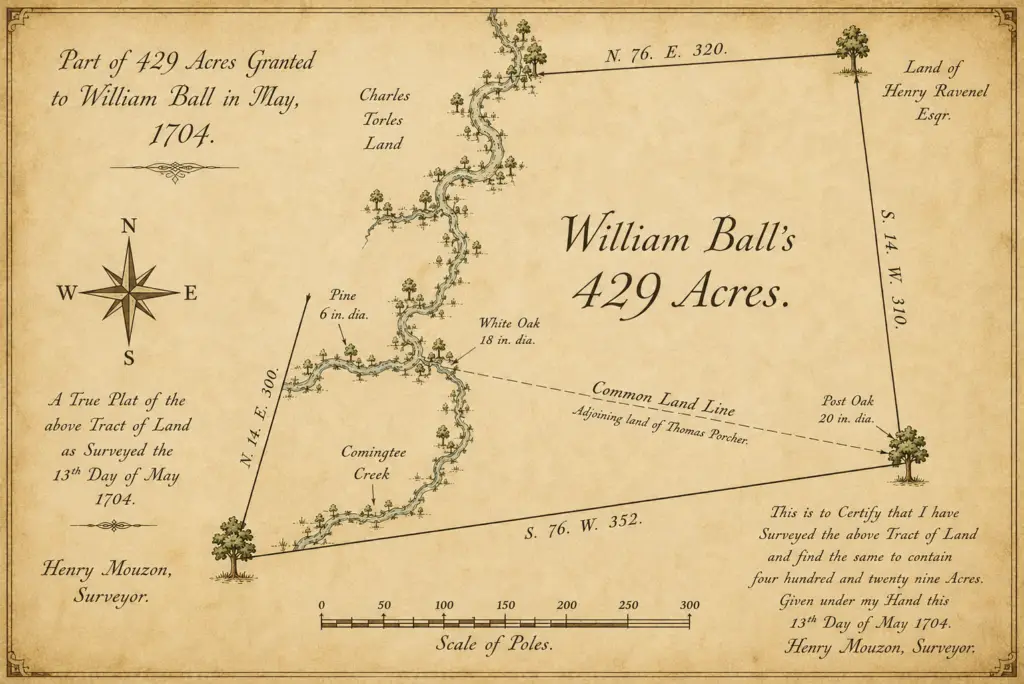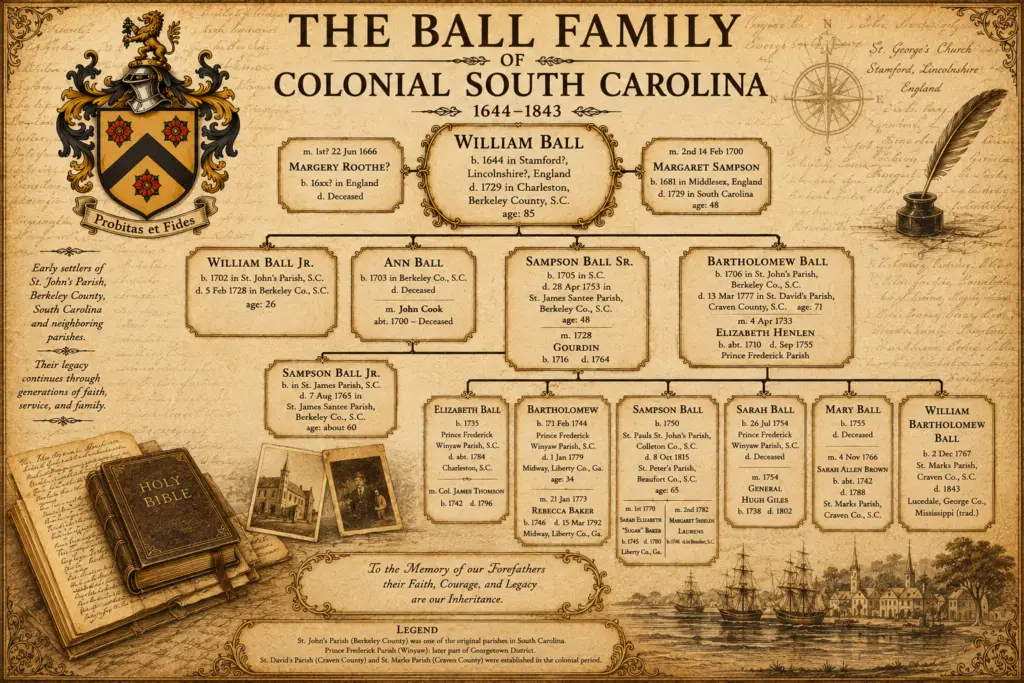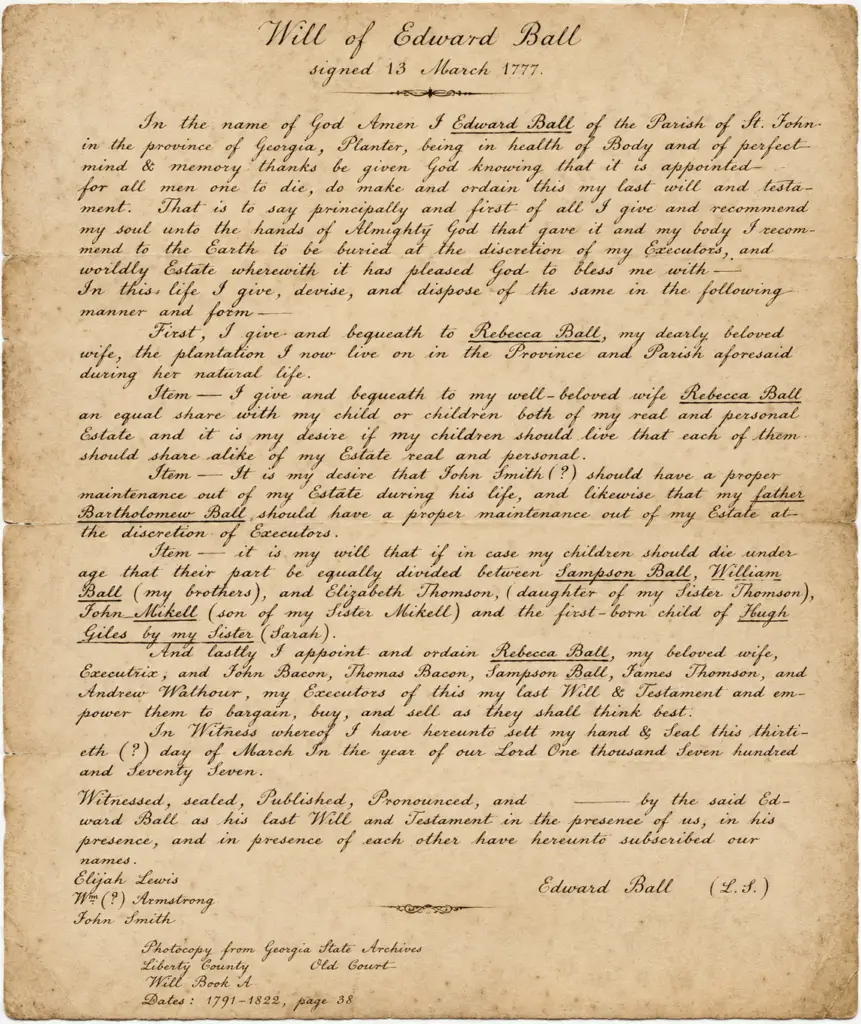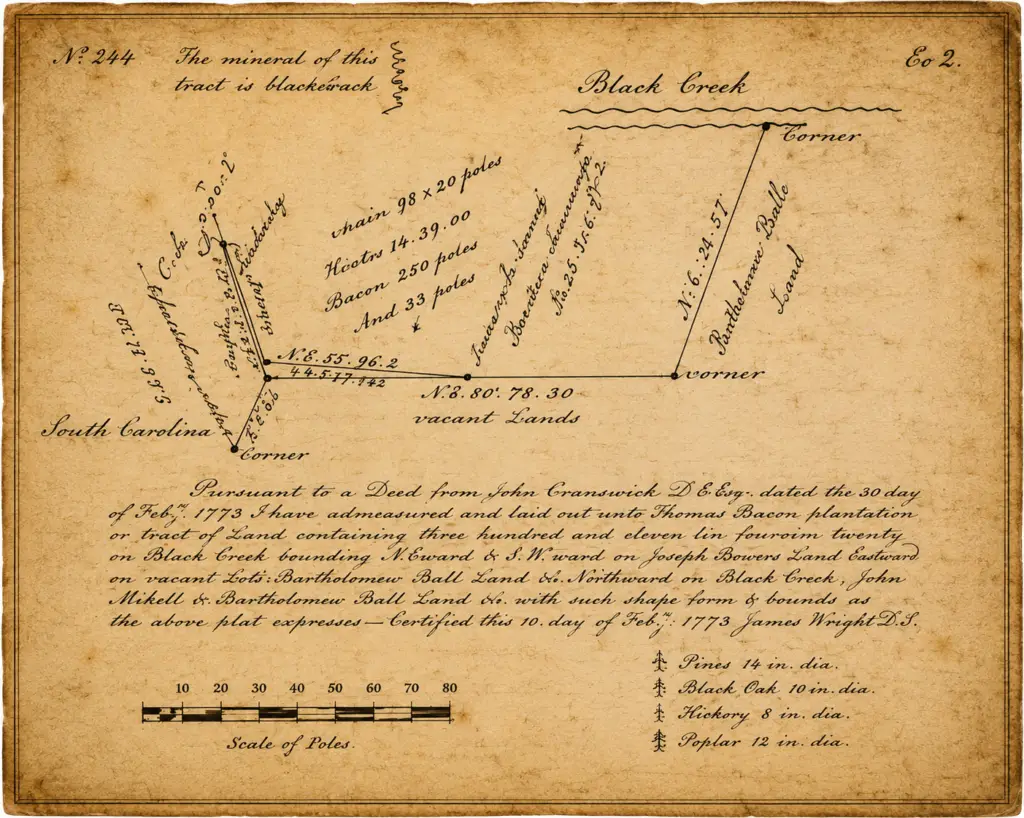
Discover the earliest generations of the Ball family in colonial South Carolina through parish registers, land grants, probate files, church records, maps, wills, and original archival documents beginning with William Ball’s arrival in the late seventeenth century.
Black Robe Regiment Collection: Richard Curtis Jr. • James Courtney • Evan Pugh • Adolph Nussmann • Oliver Hart • Richard Furman • Joseph Willis
This collection examines ministers whose preaching, church leadership, missionary work, and public influence intersected with the religious and political upheavals of the American Revolutionary era and its aftermath. The term Black Robe Regiment is used here as a historical interpretive label; it does not imply that these ministers belonged to a single formal organization. Period Loyalist writer Peter Oliver used the related phrase black Regiment for dissenting clergy active in the Revolutionary cause.
Continue Reading — Published Sources on Revolutionary Clergy and the “Black Regiment”
- Peter Oliver. Peter Oliver’s Origin & Progress of the American Rebellion: A Tory View, edited by Douglass Adair and John A. Schutz. San Marino, California: Huntington Library, 1961.
- Alice M. Baldwin. The New England Clergy and the American Revolution. Durham, North Carolina: Duke University Press, 1928.
- Alice M. Baldwin. “Sowers of Sedition: The Political Theories of Some of the New Light Presbyterian Clergy of Virginia and North Carolina.” William and Mary Quarterly, 3rd ser., 5 (1948): 52–76.
- J. T. Headley. The Chaplains and Clergy of the Revolution. New York: Charles Scribner, 1864.
- James P. Byrd. Sacred Scripture, Sacred War: The Bible and the American Revolution. New York: Oxford University Press, 2013.
- Franklin P. Cole. They Preached Liberty. New York: Fleming H. Revell Company, 1941.
First Baptist Church of Charleston — The Institutional Thread
First Baptist Church of Charleston, South Carolina provides the clearest institutional link among several ministers in this collection. The congregation traces its origins to Rev. William Screven, who led the Baptist congregation that relocated from New England to South Carolina in the late seventeenth century. Rev. Oliver Hart became pastor in 1750 and guided the Charleston church and the wider Baptist association through the decades leading into the American Revolution. After Hart’s wartime departure from Charleston, Rev. Richard Furman was called as pastor in 1787 and served until his death in 1825. This creates a direct ministerial succession connecting Screven, Hart, and Furman within the oldest Baptist church in the South.
Source: First Baptist Church of Charleston — History.
English origins→Kittery, Maine
Congregation organized 25 Sept. 1682→Charleston, South Carolina
Screven and 28 members migrated south in late 1696→Georgetown, South Carolina
Later home and burial at Screven Cemetery
This route traces Rev. William Screven and the Baptist congregation whose church life in Kittery became the foundation of First Baptist Church of Charleston.
Ministerial thread: William Screven → Oliver Hart → Richard Furman
Oliver Hart and First Baptist Charleston — Historical Video
Oliver Hart (1723–1795) was ordained in 1749, arrived in Charleston that December, and accepted the pastoral charge of the Baptist Church there in February 1750. In 1775 the South Carolina Council of Safety appointed Hart to accompany William Henry Drayton and Rev. William Tennent to the frontier to address inhabitants disaffected with the revolutionary government. His diary records the war in Charleston, the fall of the city in 1780, and his flight north through the Carolinas and Virginia before he eventually settled at Hopewell, New Jersey. Published source: Oliver Hart, “Extracts from the Diary of Rev. Oliver Hart, from A.D. 1740 to A.D. 1780, with Introductory Letter from William G. Whilden,” Year Book, City of Charleston (1896), pp. 375–401.
The Screven–Hart–Midway Connection
Rev. William Screven, founder of the Baptist congregation that became First Baptist Church of Charleston, stood at the beginning of another family connection that reaches directly into Oliver Hart’s household and the Revolutionary history of Midway, Georgia.
Thomas Smith Screven, a great-grandson of Rev. William Screven and elder brother of Gen. James Screven, married Eleanor (Nelly) Hart, daughter of Rev. Oliver Hart and Sarah Breese, on 6 March 1770. Thomas Smith Screven later served as a trustee, treasurer, and deacon in the Charleston Baptist congregation.
The two families were joined a second time after the Revolution. John Hart, son of Rev. Oliver Hart, married Mary Esther Screven, daughter of Gen. James Screven and Mary Esther Odingsell, on 17 June 1784.
Gen. James Screven, Thomas Smith Screven’s younger brother, became a leading Georgia Patriot. He was mortally wounded near Midway Meeting House in Liberty County in November 1778 and is buried in the historic Midway cemetery. General James Screven Memorial — Midway, Liberty County, Georgia Thus the Screven–Hart connection links the founding Baptist ministry of William Screven, Oliver Hart’s Charleston pastorate, and the Revolutionary struggle at Midway in one extended family network. Gen. James Screven and Lt. Edward Ball were contemporaries within the same Midway–Liberty County Revolutionary community and almost certainly knew one another, although no surviving document has yet been found proving a personal friendship.
Richard Furman appears within Oliver Hart’s own ministerial network. Hart records Furman preaching at the High Hills of Santee in January 1774 and later records assisting Rev. Richard Furman in the ordination of Joseph Cook at the High Hills of Santee. The diary introduction also places Furman among the most important South Carolina Baptist leaders of the generation that followed Hart.
Richard Furman — Patriot Preacher and Advocate of Liberty
Richard Furman (1755–1825) was ordained to the Baptist ministry at the High Hills of Santee in May 1774 by Rev. Joseph Reese and Rev. Evan Pugh. The South Carolina Encyclopedia gives the ordination date as May 10, 1774, while Leah Townsend’s South Carolina Baptists gives May 16; both sources place Pugh and Reese in the ordaining ministry. Furman’s ordination therefore directly connects him to Evan Pugh and, through Pugh, to Oliver Hart’s ministerial network.
Furman was not merely a later Baptist leader; he was an active Patriot voice during the American Revolution. Soon after his ordination in 1774, South Carolina leaders encouraged him to use his influence in the backcountry to persuade wavering settlers and Loyalist-leaning communities to support the Patriot cause. The South Carolina Encyclopedia reports that Governor John Rutledge urged Furman to plead the Patriot cause in western South Carolina rather than serve as a soldier, and that his success apparently led Lord Cornwallis to offer a £1,000 reward for his capture after the fall of Charleston in 1780.
The Baptist Courier likewise describes Furman as a faithful Patriot whose work in the Carolina backcountry made him such an effective advocate for independence that Cornwallis placed a £1,000 bounty on his head. Under that pressure Furman left South Carolina and remained away until the end of the war. Soon afterward, in 1787, he became pastor of First Baptist Church of Charleston, succeeding in the same church tradition shaped earlier by Rev. William Screven and Oliver Hart.
Furman’s Revolutionary convictions remained central to his public ministry. In an Independence Day address delivered at First Baptist Charleston on 4 July 1802, he linked the American Revolution with both liberty and religion. At the same time, the historical record also requires acknowledging that Furman later became a slaveholder and defended slavery, creating a profound contradiction between his advocacy of political and religious liberty and the institution he later defended.
Sources: The Baptist Courier, Furman and the Spirit of Revolution; South Carolina Encyclopedia, Richard Furman; Southern Baptist Historical Library & Archives, Richard Furman.
Continue Reading — Published Sources on Richard Furman
- Richard Furman. America’s Deliverance and Duty: A Sermon Preached at the Baptist Church in Charleston, South-Carolina, on the Fourth Day of July, 1802. Charleston: W. P. Young, 1802.
- James A. Rogers. Richard Furman: Life and Legacy. Macon, Georgia: Mercer University Press, 1985.
- Richard Furman. “An Address to the Residents between the Broad and Saluda Rivers concerning the American War for Independence,” November 1775, reprinted in James A. Rogers, Richard Furman: Life and Legacy, pp. 267–273.
Archival research lead. The Southern Baptist Historical Library & Archives identifies surviving Richard Furman correspondence from 1777–1825, Furman family correspondence from 1812–1853, and sermon materials in its collections. These records may provide additional primary evidence for Furman’s Revolutionary-era ministry, religious-liberty activity, and later denominational leadership.
Evan Pugh — Oliver Hart’s diary refers to Mr. Pugh, recording that he sailed for Philadelphia, accompanied Hart on a Virginia journey beginning in November 1769, and was a destination during Hart’s 1780 flight after the surrender of Charleston. Other Hart diary material identifies him explicitly as Rev. Evan Pugh. Pugh belonged to Hart’s close Baptist ministerial circle: Oliver Hart was one of the ministers who ordained Pugh at Euhaw in 1764, and Hart later visited and preached for him on the Pee Dee. Pugh later joined Rev. Joseph Reese in ordaining Richard Furman at High Hills of Santee on 10 May 1774, creating another direct link in this South Carolina Baptist ministerial network. Ball Family Association research also attributes to Rev. Evan Pugh the marriage of Sarah Ball and Hugh Giles on 4 January 1772, providing a direct connection between Pugh’s ministry and the Ball family. Published source: Evan Pugh, The Diaries of Evan Pugh, 1762–1801, transcribed by Horace Fraser Rudisill (Florence, S.C.: St. David’s Society, 1993).
Adolph Nussmann (1739–1794) was selected in Hanover to serve North Carolina’s German Lutheran congregations and arrived in America in 1773 after waiting in London for passage to Charles Town, South Carolina. He became the first resident Lutheran clergyman in North Carolina. Published institutional source: St. John’s Lutheran Church, Concord — Church History & Timeline, which records Nussmann’s 1773 arrival, his role as the first Lutheran pastor to permanently serve in North Carolina, and his ministry across a roughly fifty-mile radius. The American Revolution cut off his European correspondence, but he continued regular worship and parish-school work as conditions permitted and maintained ties with Lutheran clergy including Rev. Frederick Daser of Charles Town.
Richard Curtis Jr. and the Struggle for Religious Liberty
Reverend Richard Curtis Jr. (1755–1811) was a Revolutionary-era Baptist preacher whose life became closely associated with the struggle for religious freedom on the American frontier. Historical accounts identify Curtis as a South Carolina Patriot who served under Francis Marion during the American Revolution. He later migrated with his family and other Baptists to the Natchez District. Courtney–Curtis Boat Trip — Family Kinship
The River Journey to Natchez, 1780–1781
The Curtis party left South Carolina in 1780, crossed the Appalachian country, and reached the Holston River near present-day Kingsport, Tennessee. There they built flatboats and began the river journey westward in the fall of 1780.
Route: Holston River → Tennessee River → Ohio River → Mississippi River → Natchez District.
Near the mouth of the Clinch River, the first flatboat was attacked by Cherokee. Hannah Curtis Courtney was grazed on the head, and Jonathan Curtis was wounded in the wrist. The survivors continued down the Tennessee and Ohio Rivers, entered the Mississippi River, and reached the Natchez District about March 1781.
Source: Ball Family Association research file, Curtis_Jones_Courtney_Willis_Preacher_Report.docx, including the surviving account of the 1780–1781 flatboat migration and Cherokee attack.
Randy Willis’s historical novel Twice a Slave: Revised and Expanded Edition portrays Curtis arguing that political independence would mean little without freedom of conscience. In the scene Curtis declares, This country must be free. We must have the liberty to speak and write as we choose. He then identifies an even more fundamental liberty: the right of a person to worship God according to conscience. Curtis says that his family wants to worship Jesus Christ in peace and that he is prepared to die for that freedom.
The passage also depicts Curtis distinguishing liberty of conscience from allegiance to one denomination. He points to companions from Presbyterian, Baptist, and Congregational backgrounds. These words are reconstructed literary dialogue, not a verbatim historical quotation preserved in a letter, diary, church minute book, or military record. They are best understood as Randy Willis’s literary interpretation of the religious principles and experiences associated with Curtis.
From South Carolina to the Natchez District
Curtis was born on 28 May 1755. About 1780 he traveled from South Carolina toward the Natchez District with members of his family and other Baptist settlers. The region later came under Spanish West Florida. Curtis helped establish Salem Baptist Church at Cole’s Creek in 1791. Under Spanish authority Protestant worship faced legal restrictions, and Curtis was eventually compelled to leave the district. He later returned and continued Baptist work in the Mississippi country, with his ministry associated with congregations including Bayou Pierre, Bethel, and New Hope.
Curtis later assisted Baptist work around Beaver Creek and Ebenezer Baptist Church in what became Amite County, Mississippi. On 9 May 1806 he joined other ministers in constituting Ebenezer Baptist Church. He died on 28 October 1811 while seeking relief from cancer and was buried near Ebenezer Baptist Church.
Historical note. The Curtis dialogue quoted and summarized above comes from a historical novel. It should not be represented as Curtis’s documented verbatim words. Source of literary passage: Randy Willis, Twice a Slave: Revised and Expanded Edition, Kindle edition, Joseph’s Narrative, displayed p. 92. Kindle page numbering may vary by device and text settings.
James Courtney (1764–1846) links the Revolutionary generation of South Carolina with the early Baptist ministry of Mississippi. A Revolutionary War veteran and Baptist minister, Courtney came from South Carolina and on 9 May 1806 assisted Richard Curtis Jr., Thomas Mercer, Isaac Jackson, and Jonathan Curtis in constituting Ebenezer Baptist Church on Beaver Creek. His military, church, and family records are preserved as part of the Association’s Courtney and Revolutionary War research.
Joseph Willis (d. 1854) worked in close association with Richard Curtis Jr. in Mississippi before carrying Baptist preaching west of the Mississippi River. Historical Baptist accounts place him with Curtis in the Mississippi mission field by 1798 and record his preaching in Louisiana in 1804. In 1812 he organized the church at Bayou Chicot, one of the foundational Baptist congregations of Louisiana. Louisiana Baptists credits Willis as the first Baptist preacher west of the Mississippi River. Later published Louisiana Baptist accounts preserve a family tradition that Willis once swam the Mississippi River at Natchez riding a mule to save time in carrying the Gospel. Earlier published histories confirm that he crossed the Mississippi and began preaching in Louisiana, but they do not include the mule detail.
Published sources: William Cathcart, ed., The Baptist Encyclopedia (1881), p. 1256; The Journal of Negro History, vol. 7 (1922), on Willis’s 1804 crossing and Louisiana ministry; and Baptist Message, “Joseph Willis: The Story of the First Louisiana Baptist,” preserving the later mule-crossing tradition.
Further reading — historical fiction: Randy Willis’s Twice a Slave is a fictionalized account of Joseph Willis’s life, rooted in the author’s family history and early American research. It should be read as historical interpretation rather than as a primary or documentary source.
Joseph Willis — Descendant Narrative and Family Tradition
A man’s character is measured by what it takes to discourage him. Talent, wealth, position, and fame will fade like the autumn colors, but his character will remain for generations yet to come. — Randy Willis, 2024
Randy Willis, Joseph Willis’s fourth-great-grandson, preserves a family narrative in which Joseph was born in 1758 as a Cherokee slave to his father. According to this account, Joseph lost his father at eighteen and was then deprived by an uncle of an inheritance that would have made him one of the wealthiest men in North Carolina. He married Rachel Bradford seven years later; after four children, Rachel died in childbirth in 1794 at about age thirty-two. Joseph later married Sarah, described in the family account as an Irish orphan, and she died in 1798 after the birth of two children.
The same descendant tradition states that Joseph sought Baptist ordination but was rejected because church leaders believed the cause of Christ would suffer if a dark-skinned man were ordained. Randy Willis presents this rejection, together with the deaths of Joseph’s two wives and the loss of his inheritance, as the great crisis of Joseph’s early life. A spiritual encounter remembered by Joseph in old age is described as the turning point that renewed his sense of calling and sent him toward difficult mission fields.
According to the Willis family narrative, in the spring of 1798 Joseph and others left South Carolina, traveled overland to the Holston River in northeastern Tennessee, built flatboats, and descended the Holston, Tennessee, Ohio, and Mississippi Rivers toward the Natchez country. Near the Tennessee–Clinch confluence, the party was reportedly attacked by Cherokee, and Joseph’s knowledge of his Cherokee mother’s language helped save the travelers.
Randy Willis further relates that Joseph crossed into Spanish-controlled Louisiana Territory while restrictions on non-Catholic preaching were still in force, at one point swimming the Mississippi River on a mule. He later carried Protestant preaching into the lawless Neutral Strip, or No Man’s Land, between the Calcasieu and Sabine Rivers. In this family account, Joseph’s Cherokee ancestry and appearance helped him move among Indigenous people, fugitives, frontier settlers, and other marginalized communities in a region with little organized civil authority.
The descendant narrative credits Joseph Willis with living to age ninety-six, helping establish more than twenty churches in Mississippi and Louisiana, and leaving a religious legacy from which many later congregations developed. These details are preserved here as the interpretation and family tradition of Randy Willis and should be compared with church minutes, Baptist association records, contemporary histories, and other documentary evidence elsewhere in this collection.
Source for this descendant narrative: Randy Willis, Joseph Willis’s fourth-great-grandson; Three Winds Blowing and related Joseph Willis family research.
Joseph Willis — Documentary Evidence and Chronology
David Benedict, 1813. In A General History of the Baptist Denomination in America and Other Parts of the World, written during Joseph Willis’s lifetime, Benedict described Willis as having done much for the Baptist cause, spending a large fortune and laboring at the hazard of his life while Louisiana was under Spanish government. This is important early evidence that Willis’s ministry reached Spanish-controlled Louisiana before American rule.
Louisiana Baptist obituary, 1854. The Louisiana Baptist Associational Committee stated that the Gospel had been proclaimed by Willis in the region before the American flag was raised there. This supports a pre-American ministry, although it does not by itself establish his exact first crossing date or route.
Albert H. Newman, 1894. Newman identified the church at Bayou Chicot in 1812 as the first Baptist church formed in Louisiana and described Joseph Willis as a leading Baptist minister in Mississippi who had labored in close association with Richard Curtis. Read Newman’s account.
Louisiana Baptists. The Louisiana Baptist Convention identifies Joseph Willis as the first Baptist preacher west of the Mississippi River and credits him with founding Bayou Chicot Baptist Church in 1812. Louisiana Baptists — Our Story.
Chronology caution. Later sources do not agree on the date of Willis’s first Louisiana ministry. W. E. Paxton’s account places a preaching visit at Vermilion in November 1804, while the Dictionary of Louisiana Biography says Willis first appeared in Louisiana in 1805. Those dates sit uneasily beside Benedict’s 1813 account and the 1854 obituary, both of which point to ministry before American control. The exact date and route of Willis’s first entry into Louisiana therefore remain an open research question rather than a settled fact.
Research leads preserved in the Randy Willis material. The descendant narrative identifies several records that deserve continued comparison: the 1854 Louisiana Baptist obituary, David Benedict’s 1813 history, W. E. Paxton’s Baptist history, Spring Hill Baptist Church minutes, and Paxton’s report that Joseph Willis’s diary was entrusted to William Prince Ford in 1841. These sources should be evaluated individually and not treated as interchangeable evidence.
Additional source: Louisiana Baptists — Our Story.
Liberty of Conscience in Colonial Carolina
The religious-liberty language that shaped colonial Carolina developed through several proprietary documents. The Charter of Carolina of 24 March 1663 authorized the Lords Proprietors to grant indulgences and dispensations to settlers who could not conform to the Church of England, provided that they remained loyal, obeyed the laws, and did not disturb the peace.
In 1665 the Lords Proprietors issued the Concessions and Agreements of the Province of Carolina. Item 8 protected qualified settlers from being molested, punished, disquieted, or called in question for differences in religious opinion or practice so long as they did not disturb the civil peace, and affirmed their liberty of judgment and conscience in matters of religion. A separate 1664 New Jersey Concession and Agreement used closely related language; the two documents should be cited separately rather than treated as one constitution.
The Second Charter of Carolina of 30 June 1665 repeated and broadened this toleration principle by protecting persons granted religious liberty from punishment for religious differences when they did not disturb the civil peace. The Fundamental Constitutions of Carolina of 1669 later declared that any seven or more persons agreeing in a religion could constitute a church and that no person should be disturbed, molested, or persecuted for religious opinions or worship. At the same time, Carolina retained an established Church of England framework and other legal limitations, so this was broad colonial toleration rather than modern religious equality.
This developing legal tradition provided important space for dissenting congregations and ministers to organize in Carolina and forms part of the background to the Baptist, Presbyterian, Lutheran, and other clergy represented in this Black Robe Regiment collection.
Primary sources: Charter of Carolina, 24 March 1663; Concessions and Agreements of the Province of Carolina, 1665; Second Charter of Carolina, 30 June 1665; Fundamental Constitutions of Carolina, 1 March 1669. Yale Avalon Project.